Showing posts with label Observation Skills. Show all posts

Another -ology

You'll guess this sort of science - there are some big clues in the title of the video.

What do these two films show?

Think pair share - can you spot 5 facts from each film?

What words go with this branch of science?


Hidden Words just here...
Earth Science
Geology
crust
core
rocks
crystals
fossils
volcanoes
eruptions
lava
mountains
faults
earthquakes

What Sort of Science?

Use your Focused Thinker skills

Use your observation skills

NOW

Watch this video...


I don't believe it!

What happened?

Why did that happen?

What do we call this?

What branch of science is this?

What words go with this sort of science?

Highlight to find out more...

Chemistry
chemicals
elements eg. hydrogen, oxygen, carbon, iron, 
what things are made of
substances
materials
reactions
properties = the qualities of a material
scientists mix, heat and burn things to find out about their properties

In the Shadows!


It didn't go dark or anything
but there was something 
about the brightness of the light 
that made you feel like you where in a shadow

Everyone was gathering in the junior playground
taking turns 
to look at the Sun 
through some special viewers we had been loaned

No one was really prepared for the sight

When I first looked through the viewer 
I felt surprised and delighted at the same time
The image was so clear 
and the Moon seemed 3D.

As I looked around 
at the other people 
taking their first look at the eclipse 
I saw the same delight and surprised expressions on their face's

What surprised me most 
was the crescent shaped forms
between the shadows 
under the trees

Take a look for yourself


Crazy Inventions

Have you started finding out any information about an important invention yet?

All you need to do is:
Decide on something you are interested in
Use the internet to discover who invented this thing
When it was invented
Get some basic facts about the changes in this thing over time
Write down some ideas about how this thing has changed people's lives.

Watch this video, count and list as many inventions as you can.  Make notes in your learning journal - words - pictures.


All About Gold


The pictures and designs on the Olympic medals are symbolic of some big ideas.
Read the information below and take a close look at the medals.


The story behind the medal

The Olympic medals’ circular shape is a metaphor for the world. 
The front of the medal always has the same imagery at the Summer Games – the Greek Goddess of Victory, Nike, stepping out from the Parthenon to arrive in the Host City.

The design for the reverse features five symbolic elements:
- The curved background implies a bowl similar to the design of an amphitheatre
- The core emblem is an architectural expression, a metaphor for the modern city, and is deliberately jewel-like.   
- The grid suggests both a pulling together and a sense of outreach – an image of radiating energy that represents the athletes’ efforts.  
The River Thames in the background is a symbol for London and also suggests a fluttering baroque ribbon, adding a sense of celebration.  
- The square is the final balancing motif of the design, opposing the overall circularity of the design, emphasising its focus on the centre and reinforcing the sense of ‘place’ as in a map inset.

Medal specification

- The London 2012 Olympic medals weigh 375-400g, are 85mm in diameter and 7mm thick.
- The gold medal is made up of 92.5% silver and 1.34% gold, with the remainder copper (a minimum of 6g of gold).
- The silver medal is made up of 92.5% silver, with the remainder copper.
- The bronze medal is made up of 97.0% copper, 2.5% zinc and 0.5% tin.
The precious ore for the medals has been supplied by London 2012 sponsor Rio Tinto and was mined at Kennecott Utah Copper Mine near Salt Lake City in America, as well as from the Oyu Tolgoi project in Mongolia. For the small amount of non-precious elements that make up the bronze medals, the zinc was sourced from a mine in Australia as well as from recycled stock, while the tin originates from a mine in Cornwall.

Thinking
  • How does knowing about the meaning of the medal design help us with our class projects?
  • What does it take to earn gold?
  • What does it mean to win gold?
  • What does it mean to the athlete? the country? other people?
  • We will brainstorm words and ideas to help us with our medal and Olympic podium construction


Snow Flakes

As water freezes to make snow - tiny water crystals grow to make a unique pattern.


They say that no two snow flakes are the same.


Take a look at this video and see what you think.


Were any of these patterns the same?
What basic shape did you notice?
What do you think unique means?


Is it possible that no two snow flakes are the same?
YES NO 
Why do you think that?


Olympic Flame

Watch this short video showing the Olympic flame being lit.


Make notes in your head. (Observation Skills - looking and listening)
Try and notice five things in this video to talk about with a buddy.


As you watch think about...
Who?  What?  Where?  Why?  When?  How?


Listen Again

Listen to another soundscape.


Listen
Where are you?
How do you know where you are?
What are the key sounds that make you think that?


Discuss your thinking with your buddy.


PS.  Look at the question words I have used:
where, how, what

Soundscape Link

Observing with your EARS

Listen to the sound scape.  
Where are you?
Sound Scape Link 

How many different sound can you hear?

Count the sounds and say what they are.  Chat with your buddy.


We will show you the picture to see if you are right after you have talked.


We will turn off some sound to see if you can work out which sound is missing.


Did you guess?
The Beach


Did you here?
water, seagulls, children, a dog, a motor boat and a windsurfer.
What key sounds gave you the clue?

Observation Test

Watch this video and count all the things you spot that look odd or different.


Watch it a second time just to check you spotted everything.


Focused Conversation
Then talk with a buddy to check all the things you saw.


Expert Conversation
Talk again and try to explain what exactly changed about the things you noticed.


Extra Expert Understanding
Why have we been watching these observation videos and looking at optical illusions?  What has been the point of this?

Detective Observation Skills

Watch really carefully

Watch this short video and see if you can spot anything that changes?

Watch again.  As they film this short story 21 things are changed!

Watch again and see how many you can spot. 
(work with a buddy - make a list of what you notice)

Perspective

Perspective has a number of meanings.


1. Perspective can be about the way we look at things. It can mean your point of view.


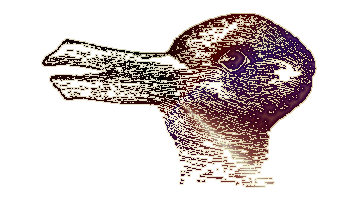
Take a few seconds to look silently at this picture.
Explain to a buddy what you see.


Take a fresh look at the same image up side down.
Now what do you see?

Here is another example.
Look - think - talk - explain (what you see and what changed)


2. Perspective is also about size, distance, near and far.


Which man is bigger?
What is happening here?


Ovservation Skills

When we look at something do we really notice all the details or do we just take a quick look and then move on?


Look 
Look again.
Anything funny?
Anything odd?
Talk with a buddy and explain what you can see here.


Can you clearly explain how this illusion has been created?


And what about this one?


Observation Skills

What do you see when you look at this picture.


Look


Look again there is more than one image to see here.


Talk to a buddy about what you see.


Here is the same picture again in black and white.
Does it help you to see anything else?


Could you see : 
a young woman looking away
an old woman looking down
can you see both images?